





In an age dominated by fast coatings and disposable finishes, linseed oil paint offers a radically different philosophy: paint that protects, nourishes, and quietly endures. Used across Europe for centuries, this deceptively simple material has safeguarded timber, ironwork, and masonry long before the advent of modern synthetic coatings. Today, it is being rediscovered by architects, preservationists, and homeowners who seek longevity rather than short-term surface perfection.
There are no synthetic binders, plastic emulsifiers, or solvent-heavy additives—just oil and pigment working together as they have for centuries.
At its core, linseed oil paint is remarkably straightforward. Flax seeds are pressed to produce raw linseed oil, which is then gently boiled to enhance durability and improve drying time. A small amount of drying agent is added, along with finely ground mineral pigments—ochres, iron oxides, and earth colors that have historically colored buildings for generations. That is the entire system.
Crucially, it allows moisture to move through the material rather than trapping it—a natural wicking action that helps prevent rot, rust, and decay.
This simplicity is also what gives the paint its unusual performance. Rather than sitting on the surface as a brittle film, linseed oil paint penetrates the material beneath it. On timber, the oil nourishes the fibers while the pigment protects the surface from ultraviolet light. On metal, it creates a barrier that resists corrosion. On masonry and plaster, it forms a durable finish that remains flexible and stable.
Instead of blistering, flaking, or peeling, the paint slowly softens to a gentle matte patina.
The historical record speaks clearly. Across Scandinavia and northern Europe, original coats of linseed oil paint have survived on buildings for hundreds of years. These finishes age gradually rather than failing catastrophically. When the surface eventually needs attention, maintenance is simple: a light wipe of linseed oil refreshes the finish and restores its depth, often after many years of service.
Application is equally uncomplicated. Linseed oil paint is typically brushed directly onto a clean surface without the elaborate layering systems common with modern paints. Because the paint is thin and highly pigmented, coverage is substantial—often between 15 and 20 square meters per liter depending on the substrate. One coat is often sufficient, though absorbent timber may benefit from two. Additional coats can be applied if a deeper satin or semi-gloss finish is desired.
Drying occurs through exposure to ultraviolet light, a natural curing process that generally completes within about 24 hours under normal conditions. The resulting surface is exceptionally hard and durable, capable of withstanding years of weather exposure without the cracking and peeling associated with synthetic coatings.
One of the most compelling aspects of linseed oil paint is its versatility. The same formulation can be used across a wide range of materials—timber, plaster, masonry, and metal—eliminating the need for multiple specialty products. Even unconventional surfaces, such as uPVC, can be coated when properly prepared.
 Despite its longevity, linseed oil paint is often surprisingly economical. Its high coverage rate means a relatively small amount of paint goes a long way, and the long maintenance cycles dramatically reduce the need for frequent repainting. Over time, the true cost advantage becomes clear: surfaces remain protected for decades rather than requiring repeated stripping and recoating.
Environmental considerations are another reason the material is attracting renewed attention. Because the paint is made primarily from natural flax oil and mineral pigments, it avoids the heavy chemical processing and petroleum-based ingredients common in many modern coatings. The result is a paint with a gentle, natural scent and none of the harsh solvent fumes that often accompany synthetic alternatives.
Ultimately, linseed oil paint represents a different way of thinking about materials. It is not designed for quick turnover or short repainting cycles. Instead, it reflects an older philosophy of building maintenance—one where surfaces are cared for gradually, materials age gracefully, and longevity is valued over convenience.
 Long before paint factories and industrial mixers, artists and decorators made their own paint by hand. The process was simple in principle but demanding in practice. Pigments—finely ground mineral powders—were combined with oil using a muller, a small grinding tool, and a flat stone slab. By slowly working the pigment into the oil, the maker created a smooth paste that could then be adjusted to the desired consistency.
The balance of oil and pigment depended on the purpose. Artists typically used a thicker mixture with less oil to achieve dense, expressive color. House painters, on the other hand, added more oil to produce a thinner paint capable of covering large surfaces efficiently. The method worked, but it required patience and skill. Achieving a consistent result from batch to batch was difficult, and the paint’s durability depended entirely on how thoroughly the pigment and oil were blended.
That challenge remains fundamental even today. For linseed oil paint to perform properly, the pigment particles must be completely and evenly dispersed within the oil. If the mixture is poorly combined, the paint will lose its depth of color more quickly, and the surface will become matte sooner than expected, increasing the need for maintenance.
Modern manufacturing refines this traditional process without changing its essential principles. At Brouns & Co, the journey begins far from the factory floor—in the flax fields of Yorkshire. There, flax is cultivated specifically for paint production. When harvested and pressed, the seeds yield raw linseed oil, the foundational ingredient that carries and binds the pigments.
This oil is then gently boiled to create boiled linseed oil, improving its durability and helping the paint cure more effectively once applied. From there, the oil meets the pigments.
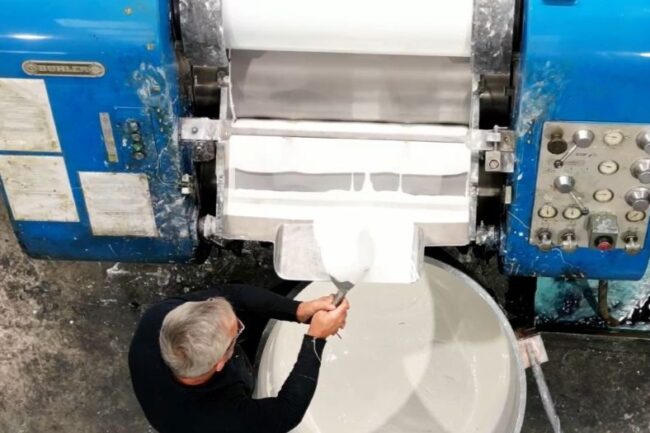
Instead of the hand-held mullers of earlier centuries, the mixing process now begins in large column mixers and barrels, where oil and pigment are combined into a thick paste. This mixture is then passed through a triple roller mill, a machine designed to grind and disperse the pigments with extraordinary precision.
The paste travels between three steel rollers several times—typically three to five passes—depending on the grain size of the pigments. Each pass refines the mixture further, breaking down pigment particles and distributing them evenly through the oil. The result is a beautifully smooth, homogeneous paint base from which the final colors are developed.
Temperature control is critical during this stage. The friction created as the rollers turn generates considerable heat. If the oil becomes too warm, it thins and the pigments struggle to bind properly. To prevent this, the rollers are engineered to maintain a constant flow of cooling water through them, keeping the paint mixture at a stable temperature and preserving the integrity of the oil.
Despite the presence of modern machinery, the underlying technique remains essentially unchanged from the methods used centuries ago: pigment carefully ground into boiled linseed oil. It is this commitment to a slower, more precise process that distinguishes linseed oil paint from most modern coatings.
Producing paint in this way inevitably requires more time and care than the industrial production of synthetic paints, which often rely on fillers, plastic binders, and chemical emulsifiers to simplify manufacturing. Yet the extra effort is reflected in the performance of the final product. Linseed oil paint spreads thinly, covers exceptionally well, and forms a durable finish that can last for decades.
In practical terms, a liter of linseed oil paint often covers far more surface area than modern plastic paints, meaning that although the manufacturing process is more involved, the paint itself proves remarkably economical in use.