


Preserving Craft, Color, and Character
Brouns & Co at the Edenton Preservation Seminar
Recreating Original Cupola House Paint Michiel Brouns, Brouns & Galloway
-
 Friday, March 20th, 2026 3:00 PM
1767 Chowan County Courthouse, 117 East King Street, Edenton, NC
This March 20th- 21st, the Edenton Preservation Seminar: Innovating Preservation in Small-Town America will bring together leading preservationists, architectural historians, scientists, and craftspeople in one of the most historically significant towns in the United States. Sponsored by the Elizabeth Vann Moore Foundation and the Edenton Historical Commission, with generous support from the Richard H. Jenrette, Jr. Foundation, the two-day gathering will explore how traditional building knowledge and modern research can work together to protect America’s earliest architecture.
For Brouns & Co, this seminar represents something deeply familiar: the meeting point between material authenticity, historic color, and long-term stewardship.
The Cupola House: A Landmark of American Architecture
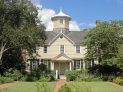
At the heart of the program stands the Cupola House (1758)—widely regarded as one of the most important historic houses on the East Coast. Few buildings so clearly express the refinement of early American craftsmanship: from its rare cupola and Georgian proportions to its extraordinary interior woodwork, much of which was recently returned after decades at the Brooklyn Museum.
The house has long been championed by architectural historian Ralph Harvard, whose scholarship and advocacy have helped establish the Cupola House as a benchmark for understanding colonial design, construction, and decorative practice in the American South. His involvement has reinforced the building’s role not only as a treasured monument, but as an educational resource for architects, conservators, and material specialists working today.
During the seminar, the Cupola House will serve as both subject and setting—hosting lectures, architectural tours, and an evening reception that will allow attendees to study its finishes, surfaces, and structure firsthand.
Recreating Historic Paint, Honestly
Among the featured presentations will be “Recreating Original Cupola House Paint,” delivered by Michiel Brouns, focusing on how early pigments, oils, and binders can be studied, matched, and re-created using historically accurate methods.
Paint, after all, is not decoration alone—it is evidence.
Layers of pigment record how buildings were used, altered, and valued over centuries. When restored incorrectly, that record is flattened. When restored with care, it becomes legible again.
For preservation professionals, this session will address:
How early linseed oil paints were formulated
Why modern coatings often distort historic surfaces
How pigment analysis informs authentic color decisions
And how traditional finishes protect timber while allowing buildings to age with dignity
It is precisely this philosophy—materials that work with buildings rather than against them—that has guided Brouns & Co’s work across Europe and North America.
Hayes Farm and the Gold Standard of Stewardship
The second day of the seminar will focus on Hayes, one of North Carolina’s most important estates, now owned by the State through a public-private partnership with the Elizabeth Vann Moore Foundation—an organization widely recognized for its exceptional standards of architectural stewardship and scholarly rigor.
Alongside the Richard H. Jenrette, Jr. Foundation, the Moore Foundation represents the very highest tier of preservation leadership in the United States. Their involvement signals not only financial commitment, but a philosophy: restoration should be slow, evidence-based, and uncompromising in its respect for original materials.
Sessions at Hayes will explore:
Historic paint analysis
Dendrochronology
Ground-penetrating radar
Period-accurate furnishing
Textile reproduction
And 3-D digital documentation of early structures
Together, these methods form a new preservation toolkit—one that still begins with the oldest tools of all: oil, pigment, timber, and human hands.
Why This Matters
Small towns like Edenton are often where America’s architectural memory survives most intact. They are also where it is most vulnerable.
The upcoming Edenton Preservation Seminar will demonstrate that the future of preservation does not lie in replacing traditional materials, but in understanding them more deeply—scientifically, historically, and practically.
For Brouns & Co, participation in this dialogue is not incidental. It reflects a shared belief with the seminar’s organizers and foundations:
That buildings are not frozen in time.
That paint is architecture.
And that craft, when respected, becomes a form of conservation.
As Edenton prepares to welcome scholars and practitioners this March, it will also quietly affirm something larger—that the most advanced preservation work in America is often grounded in the oldest knowledge of all.